
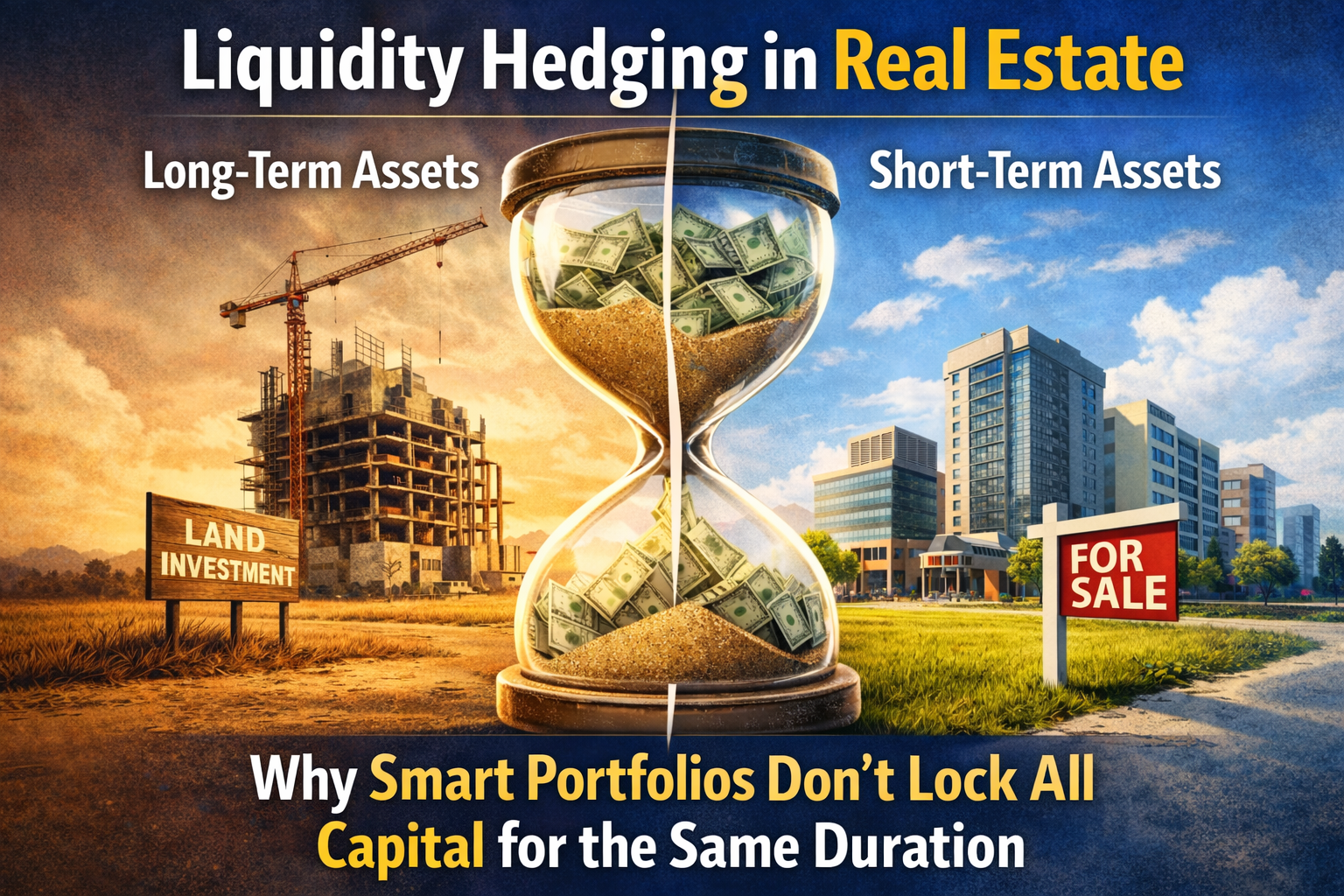
One of the biggest mistakes I see in real estate portfolios isn’t about location or price.
It’s about liquidity mismatch.
Many investors unknowingly build portfolios where every asset demands patience, long holding periods, and perfect market timing. When capital is needed urgently, even good assets start to feel like bad investments.
Liquidity, like risk, must be hedged.
Let me explain how this works in practice.
A few years ago, while reviewing a real estate portfolio, we noticed a clear pattern. Most of the capital was tied up in long-horizon assets—large land parcels and development-linked investments where value would unlock over time. The appreciation potential was strong, but exits were slow and dependent on multiple external triggers.
Instead of chasing returns, we focused on restructuring liquidity.
🧭 Step One: Accept That All Capital Shouldn’t Wait for the Same Future
We intentionally structured the portfolio across two time horizons.
⏳ Long-Term Assets Land banking and strategic parcels where value depends on zoning, infrastructure, or development milestones. These assets are built for compounding, not quick exits. Liquidity is low by nature, but long-term value can be meaningful.
⚡ Short-Horizon, Liquid Assets Smaller plots, ready assets, or locations with active secondary markets. These were chosen not for maximum appreciation, but for ease of exit, leasing, or refinancing when liquidity was required.
💡 The Hedge in Action
If markets slowed or approvals took longer than expected, liquidity came from the short-horizon assets. There was no pressure to exit long-term holdings early or at discounted values.
Capital needs were met without disturbing the core investment thesis.
That’s liquidity hedging in real estate.
🔍 What Liquidity Hedging Really Means
Liquidity hedging is not about frequent buying and selling. It’s about designing a portfolio where time works in layers. Long-term assets compound quietly. Short-term assets provide flexibility and optionality.
⚠️ Where Most Investors Go Wrong
Most investors lock everything for the long term and assume patience alone will solve liquidity. When reality intervenes—opportunity, obligation, or market cycles—decisions become forced.
That’s not patience. That’s concentration risk.
🧠 Closing Thought
If all your real estate investments need the same holding period, the same market conditions, and the same exit window to succeed, liquidity is not planned—it’s assumed.
Real wealth is built when capital can wait where it should and move when it must.